Data-Driven Restroom Excellence: How IoT Technology Revolutionizes Facility Management in 2025
Smart restroom technology has fundamentally transformed how institutional and commercial facilities approach hygiene management, operational efficiency, and user satisfaction. Once viewed as maintenance-heavy necessities relegated to the background of facility operations, restrooms have emerged as strategic test cases for advanced, connected facility management systems. By integrating Internet of Things (IoT) sensors, touchless fixtures, automated systems, and data-driven intelligence, forward-thinking organizations are achieving unprecedented levels of cleanliness, cost efficiency, and occupant satisfaction. This comprehensive guide explores how smart restroom solutions are reshaping facility management practices across hospitals, airports, corporate offices, schools, and shopping malls worldwide.

The Evolution from Reactive to Proactive Restroom Management
The traditional approach to restroom maintenance relied on fixed schedules, clipboard inspections, and reactive responses to complaints. Facilities managers would dispatch cleaning staff at predetermined intervals without considering actual usage patterns, cleanliness conditions, or supply levels. This inefficient system resulted in three critical problems: wasted labor on unnecessary inspections, inadequate cleaning during high-traffic periods, and supply stockouts that created poor user experiences. The shift toward smart restroom management represents a paradigm change from intuition-based operations to evidence-based facility intelligence.
Modern facilities management fundamentally differs because it leverages real-time data collection and predictive analytics. Instead of guessing when a restroom needs attention, IoT-equipped sensors continuously monitor cleanliness indicators, occupancy levels, fixture functionality, and consumable supplies. This transformation moves cleaning teams from reactive service calls to proactive maintenance scheduling based on actual conditions. The COVID-19 pandemic accelerated this transition, as building occupants now demand higher hygiene standards and expect visible evidence that facilities prioritize cleanliness and safety. In fact, global research shows that over 80 percent of facility users would avoid returning to establishments with dirty restrooms, making restroom cleanliness a critical factor in brand reputation and customer retention.
“Cleanliness or hygiene in a restroom was always nice to have, but now it’s what users and customers expect when they go into a restroom.” — Cassie Keeler, Product Manager of Handwashing Products, Bradley Company
The best-performing facilities now use data and technology to stay ahead of issues before they compromise user experiences. Facility managers access comprehensive dashboards displaying real-time restroom conditions, automated alerts for maintenance needs, and historical usage patterns that inform future planning. This data-driven approach eliminates guesswork, reduces operational expenses, and ensures that resources flow to areas where they’re genuinely needed.
Core IoT Technologies Transforming Restroom Operations
Smart restroom systems integrate multiple interconnected technologies that work seamlessly to create intelligent, responsive facilities. Understanding these core components provides insight into how data-driven management delivers superior outcomes. The foundation begins with sophisticated sensor arrays specifically designed to capture relevant metrics in restroom environments. These sensors include motion detectors that track occupancy and usage frequency, maintaining records of when facilities experience peak demand and quiet periods.
Occupancy and Usage Sensors form the backbone of smart restroom intelligence. Passive infrared (PIR) motion sensors detect when spaces are occupied, while people counter technologies track the total number of users throughout the day. This data reveals crucial patterns: which hours experience heaviest usage, whether peak times correlate with specific building activities, and how usage varies by day of week. Facilities can then optimize cleaning schedules precisely around these patterns rather than following arbitrary intervals. For example, if data shows restrooms experience maximum traffic between noon and 1 p.m., cleaning staff can prioritize deep maintenance during early morning or late evening hours when foot traffic is minimal.
Consumable Level Monitoring eliminates the costly problem of stockouts and overstock situations. IoT-enabled dispensers for soap, paper towels, toilet paper, and sanitizer include sensors that transmit real-time inventory levels to a centralized platform. Facility managers receive automated alerts when supplies drop below specific thresholds, triggering timely reorders. Visual color-changing monitors on dispensers themselves—shifting from green to yellow to red as supplies deplete—provide immediate visual feedback to cleaning staff about what needs attention. This precise inventory tracking prevents the frustrating experience of empty dispensers while reducing unnecessary purchasing and waste from premature replacements.
Water Leakage Detection represents a significant sustainability advantage, particularly relevant as organizations worldwide embrace water conservation goals. Specialized sensors installed in fixtures and surrounding areas detect even minor drips before they escalate into serious problems. A seemingly insignificant leak can waste thousands of gallons annually and cause structural damage. Smart detection systems alert maintenance personnel immediately, enabling rapid repairs that prevent major water waste and costly repairs. Advanced systems can estimate water loss volume and project potential damage, helping facilities managers prioritize resources appropriately.
Air Quality and Odor Sensors monitor environmental conditions that directly impact user comfort and perception. These sensors detect ammonia levels, volatile organic compounds, and other odor-causing substances, triggering automated ventilation system adjustments or alerting staff when enhanced cleaning is required. When air quality readings fall below acceptable thresholds, the system automatically activates scent management systems and increases ventilation, ensuring that spaces consistently feel fresh and clean. This proactive approach prevents the negative perception that arises from unpleasant odors.
Fixture Performance Monitoring extends sensor intelligence to plumbing fixtures themselves. Smart faucets, toilets, and urinals include sensors that detect malfunctions such as improper flushing, water flow irregularities, or mechanical failures. These fixtures communicate directly with facility management systems, enabling predictive maintenance scheduling. Instead of waiting for complaints about malfunctioning equipment, facilities managers receive automated notifications of issues and can arrange repairs during convenient maintenance windows, minimizing disruption to building occupants.

Immediate Benefits: Cost Reduction and Resource Optimization
The financial justification for smart restroom investment becomes evident through concrete, measurable savings that facilities observe within months of implementation. Organizations implementing IoT-based restroom management systems report consistent achievements across multiple cost categories. Hartsfield-Jackson Atlanta International Airport, one of the world’s busiest airports, provides a compelling real-world case study. During their connected restroom pilot program spanning from June 2018 to February 2020, the airport achieved remarkable results: outages from toilet tissue, paper towels, soap, and hand sanitizer dropped by 51 percent. Tissue waste decreased by 40 percent as rolls could be changed based on actual usage patterns rather than arbitrary shift-based schedules.
Labor Productivity Improvements represent the largest cost savings category for most organizations. Traditional restroom maintenance often required staff to conduct scheduled checks regardless of actual conditions, resulting in wasted hours on unnecessary inspections in lightly-used facilities and inadequate attention during peak periods. Smart systems eliminate this inefficiency by directing cleaning personnel only to areas requiring immediate attention. Facilities using real-time data report that janitorial teams complete their duties in approximately 20 percent less time while maintaining higher cleanliness standards. Staff can focus enhanced effort on high-traffic areas genuinely requiring frequent maintenance rather than performing uniform maintenance intervals across all facilities.
Supply Chain Optimization delivers immediate savings through precision inventory management. Without data-driven insights, facility managers struggle to determine appropriate stock levels, often erring toward overstock to avoid running out. IoT-enabled dispensers provide exact usage data, enabling accurate forecasting. Facilities report reducing consumable waste by as much as 30 percent, with some advanced implementations achieving 80 percent reductions. These reductions translate directly to procurement savings and reduced environmental impact. A large corporate office building utilizing smart restroom technology reduced its annual toilet paper consumption by approximately 40 percent while simultaneously improving user satisfaction—a seemingly paradoxical achievement that occurs because the system eliminates hoarding behavior and ensures consistent supply availability rather than feast-or-famine cycles.
Preventive Maintenance Advantages prevent costly emergency repairs that disrupt operations. By detecting plumbing failures, fixture malfunctions, and water leaks early, facilities avoid expensive emergency service calls and potential water damage. One major airport reported that early detection of a significant water leak prevented projected damage exceeding $50,000. When facilities shift from reactive emergency repairs to proactive maintenance scheduling, they extend equipment lifespan, avoid operational disruptions, and reduce total cost of ownership substantially.
Energy and Water Consumption Reductions support both financial objectives and environmental sustainability goals. Smart restroom systems integrate with building automation systems to optimize lighting, ventilation, and water usage. Motion sensors ensure lighting activates only when spaces are occupied, and smart ventilation systems adjust intensity based on actual air quality readings. Water-saving fixtures combined with usage-based operation reduce consumption significantly. Organizations report water savings of 20 to 50 percent depending on baseline conditions and technology sophistication. These reductions accumulate into substantial utility bill decreases, particularly in large facilities with extensive restroom networks.
Strategic Facility Management Through Data-Driven Insights
Data represents the genuine competitive advantage of modern facility management, transforming restrooms from merely functional spaces into intelligence-gathering points that inform broader facility strategy. The analytics capabilities embedded in innovative restroom platforms enable facility managers to understand building operations through restroom activity patterns. When restroom data sits alongside other building systems, facility managers gain unprecedented visibility into facility utilization, occupant behavior patterns, and operational inefficiencies.
Usage Pattern Analysis reveals crucial insights about facility operations. By tracking how many people use specific restrooms at various times, facility managers understand building utilization rates, peak hours, and seasonal variations. In corporate offices, usage patterns might reveal that certain floors experience higher activity than others, potentially informing hot-desking arrangements or resource allocation decisions. In schools and universities, patterns identify high-traffic periods that inform cleaning schedules and capital planning for facility expansion. Airports and transportation hubs use this data to optimize restroom staffing levels and determine where additional facilities are needed to maintain service levels.
Predictive Maintenance Capabilities extend beyond immediate operational needs to support strategic capital planning. Historical performance data enables facility managers to predict when equipment will require replacement, allowing budgeting and planning rather than responding to unexpected failures. Instead of experiencing surprise equipment failures that disrupt operations and require emergency expenditures, facility managers can schedule replacements during planned maintenance windows. This predictive approach reduces downtime, extends asset life through consistent maintenance, and ensures resource allocation aligns with actual needs rather than responding to crises.
Compliance and Regulatory Documentation becomes effortless through automated data collection and reporting. Healthcare facilities, food service establishments, and public venues operate under strict sanitation standards. Manual compliance documentation requires facility staff to conduct inspections and complete paperwork, creating opportunities for inconsistency and errors. Smart systems automatically collect and document all relevant metrics, generating compliance reports that demonstrate facilities consistently meet or exceed regulatory standards. This automated documentation protects organizations from compliance violations and provides clear evidence of good-faith adherence to health codes.
Occupant Satisfaction Enhancement flows directly from improved facility conditions. When restrooms consistently meet high cleanliness standards, users experience greater confidence in facility management and brand reputation. Research demonstrates that facilities using smart restroom technology report a 2-fold increase in restroom visitor satisfaction compared to baseline conditions. Improved user perception of facility quality influences overall satisfaction with the entire building, affecting employee retention, customer loyalty, and commercial property valuations.
Integrated System Design: Beyond Individual Components
While specific technologies deliver individual benefits, the genuine power of smart restrooms emerges from thoughtful integration of multiple systems into cohesive solutions. Leading facilities increasingly adopt integrated designs that combine functionality, efficiency, and user satisfaction through deliberate architectural planning. Rather than retrofitting standalone devices into existing spaces, innovative facilities design positions fixtures and dispensers strategically to minimize user touchpoints and simplify cleaning.
Integrated Fixture Layouts demonstrate how thoughtful design amplifies technology benefits. Imagine restrooms where the hand washing sink sits between paper towel dispensers and hand dryers, with integrated waste receptacles positioned conveniently for easy access. This arrangement ensures that the complete hand hygiene process flows naturally, reducing paper and water scattered across floors. Users navigate intuitively from soap to water to drying without confusion, and cleaning staff identify which areas require attention quickly. Integrated systems create visual coherence that reinforces perception of facility quality and attention to detail.
Accessibility and Inclusive Design must permeate smart restroom planning from initial conceptualization. Thoughtful facilities consider users of all ages and abilities, including elderly visitors, wheelchair users, parents with strollers, and individuals requiring assistance. Beyond meeting legal accessibility requirements under Americans with Disabilities Act standards, inclusive design demonstrates organizational commitment to serving all community members with dignity. Grab bars, accessible sink heights, emergency communication systems, and adequate maneuvering space benefit not only people with permanent disabilities but also temporary situations like pregnancy or short-term injury. Facilities featuring excellent accessibility consistently receive higher satisfaction ratings from all users regardless of accessibility needs, as the design generally improves usability for everyone.
Security and Privacy Integration addresses legitimate concerns about surveillance in sensitive spaces. Smart restroom systems employ occupancy sensors that detect presence without capturing identifying information, motion detectors that trigger cleaning alerts without recording video, and environmental sensors that communicate conditions without observing individual users. This architecture protects user privacy while providing facility management with actionable intelligence about facility conditions and utilization.

Emerging Technologies and Future Directions
The smart restroom landscape continues evolving rapidly as manufacturers innovate and organizations identify new applications for connected facility technologies. Several emerging trends signal the direction of future development and present opportunities for early adopters seeking competitive advantages. Artificial intelligence and machine learning algorithms are beginning to appear in advanced restroom management platforms, enabling systems to learn facility-specific patterns and make increasingly sophisticated predictions. AI-driven analytics can identify subtle patterns in usage variations that human analysis might miss, enabling ever-more precise optimization of cleaning schedules and resource allocation.
Health Monitoring Integration represents a frontier where smart toilets move beyond facility management to support personal wellness and public health surveillance. Advanced systems can analyze biological markers in waste to detect certain health conditions, dehydration levels, or dietary patterns. While privacy considerations require careful implementation, these capabilities suggest future applications in healthcare settings where such monitoring could support patient recovery or early disease detection. Public health applications might track community health trends through aggregated anonymized data from connected facilities.
Adaptive Environmental Controls promise increasingly sophisticated integration between restroom systems and broader building automation. Rather than simply responding to current conditions, advanced systems might anticipate needs based on occupancy predictions, weather conditions, and historical patterns. Ventilation intensity might adjust not just to current air quality but to predicted density based on scheduled building events. Lighting might gradually shift color temperature as time progresses, supporting circadian rhythms. Water temperature settings might optimize automatically based on time of day and anticipated usage patterns.
Sustainability Enhancements will continue accelerating as organizations prioritize environmental responsibility. Advanced greywater recycling systems might capture and reuse water from sinks for toilet flushing, reducing overall consumption. Solar-powered hand dryers and lighting systems might eliminate grid dependence for certain functions. Compostable waste systems and water-purification technologies integrated into restroom fixtures promise closed-loop systems where facilities generate minimal external waste or water consumption. These innovations align with corporate sustainability commitments and regulatory trends pushing organizations toward environmental responsibility.
Blockchain and Distributed Technology applications might address security and transparency concerns in facility management. Distributed ledgers could maintain immutable records of maintenance activities, compliance checks, and work performed by contractors, creating transparent documentation suitable for sensitive facilities like hospitals or regulatory environments. This technology could also facilitate secure sharing of facility information between building management companies, contractors, and occupants without compromising privacy.
Implementation Strategies and Organizational Change
Successfully deploying smart restroom technology requires more than installing sensors and software; it demands thoughtful organizational change management and strategic phasing. Organizations implementing these systems achieve superior results when they combine technology deployment with staff training, process redesign, and cultural shifts toward data-driven decision-making.
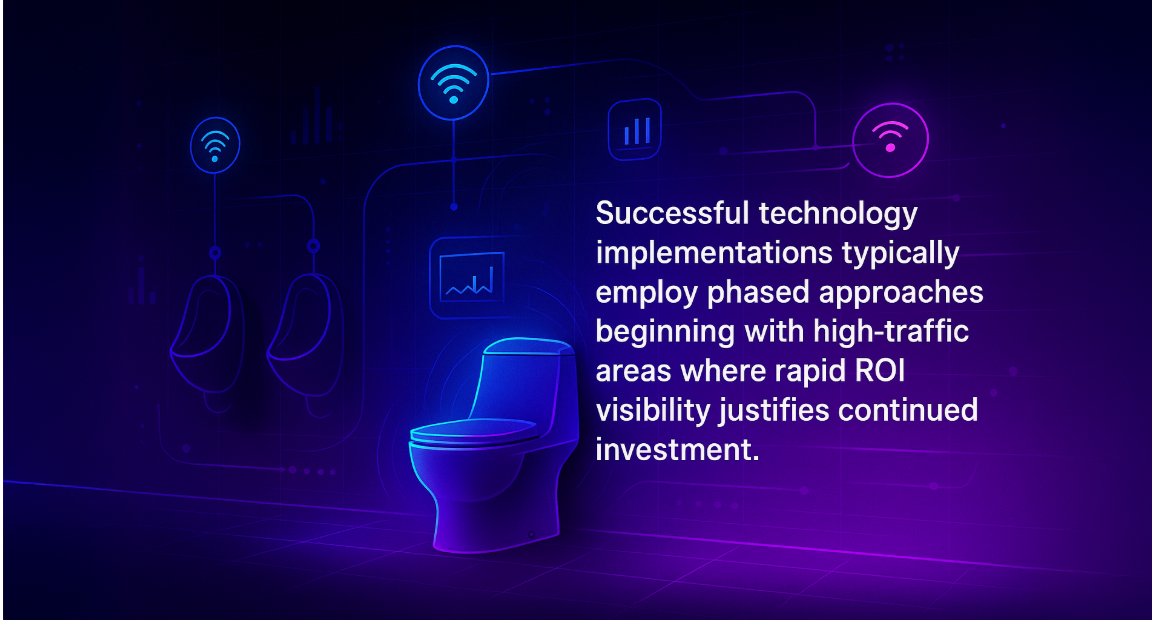
Phased Implementation Approach enables organizations to learn from initial deployments and optimize subsequent phases. Rather than simultaneously upgrading all restrooms, facilities often begin with high-traffic areas where ROI returns quickly and results become visible to building occupants. Success stories in initial locations build organizational confidence and justify continued investment. Early phases also provide opportunities to train staff, refine processes, and identify integration challenges before scaling to entire facility portfolios.
Staff Training and Culture Development ensures that facility teams embrace technology rather than resist it. Janitorial and maintenance staff need training on system interfaces, alert interpretation, and how data-driven scheduling differs from traditional approaches. When staff understand how technology supports rather than replaces their work, and when they see tools making their jobs easier and more focused, adoption accelerates. Regular team meetings that discuss facility metrics, celebrate improvements, and involve staff in optimization decisions build organizational commitment to data-driven operations.
Change Management Communication must position smart restrooms as beneficial to facility staff and building occupants. Messaging should emphasize improved working conditions for janitorial teams—less time on unnecessary inspections, more focus on high-priority areas, and better tools supporting their work. For occupants, communication highlights improved hygiene, consistent supply availability, and facility leadership commitment to cleanliness and comfort. Transparent communication about data collection practices and privacy protections addresses legitimate concerns about surveillance.
Robotic Restroom Hygiene Solutions with IoT and Recurrent Neural Networks for Clean Facilities
Real-World Application: Lessons from Leading Facilities
Multiple organizations have pioneered smart restroom implementations, offering valuable lessons for organizations considering these investments. Changi Airport in Singapore, renowned for impeccable restroom facilities, deployed IoT waste bin sensors that detect fill levels and send cleaning alerts via mobile apps. This system enables staff to empty bins based on actual needs rather than fixed schedules, maintaining consistent quality in facilities experiencing variable daily traffic. The airport’s approach demonstrates how smart technologies support premium facility standards in high-volume environments.
Belo Horizonte Airport in Brazil implemented access counting software and real-time monitoring of cleaning routines, giving operations centers visibility into facility usage and cleaning team activities. The airport developed electronic checklists using Office 365, enabling staff to rapidly assess restroom conditions and document satisfaction scores. This combination of occupancy monitoring and real-time staff performance tracking created continuous improvement feedback loops where operations and cleaning teams meet twice daily to discuss performance indicators and implement corrective actions. The structured approach ensures consistent quality through visible accountability and data-driven problem-solving.
Hospital implementations demonstrate health sector applications of smart restroom technology. Many healthcare facilities deployed IoT buttons in restrooms enabling users to immediately report cleanliness concerns. Housekeeping staff receive instant alerts enabling rapid response, transforming restroom maintenance from scheduled intervals to user-responsive service. Healthcare workers can request thorough cleaning when they observe problems, and facility managers can track response times and closure rates, identifying patterns requiring systemic improvements.
Corporate office implementations focus on employee satisfaction and resource optimization. Large financial services firms implementing smart restrooms report improved employee satisfaction scores in facility quality surveys. Employees appreciate consistent restroom conditions reflecting organizational care for their comfort and well-being. From an operational perspective, precise inventory data enables procurement departments to establish efficient purchasing relationships with vendors, reducing both product costs and delivery frequency.

Addressing Implementation Challenges and Considerations
While smart restroom benefits are substantial, organizations should acknowledge and address genuine challenges accompanying these investments. Understanding obstacles enables better preparation and problem-solving when difficulties arise. Initial Capital Investment represents the first hurdle, particularly for organizations upgrading large facility portfolios. Quality IoT sensor systems, installation labor, software platforms, and integration with existing facility management systems require significant upfront expenditures. However, ROI calculations typically justify investment within 18 to 36 months as operational savings accumulate. Phased implementation approaches enable organizations to manage capital requirements across multiple budgeting periods.
Technical Integration Complexity poses challenges when connecting diverse equipment from different manufacturers into unified platforms. Ensuring interoperability between faucets, dispensers, sensors, and software requires standardized communication protocols and careful system architecture planning. Organizations should prioritize platforms using open standards and require vendor commitments to maintain compatibility as systems evolve.
Staff Adoption and Training Needs shouldn’t be underestimated, particularly when introducing technology to traditionally non-technical facility staff. Comprehensive training, intuitive user interfaces, and ongoing support are essential for successful adoption. Organizations should allocate budget and time for change management activities, recognizing that technology implementation succeeds only when people enthusiastically embrace new approaches.
Data Privacy and Security Concerns require careful attention, particularly in sensitive environments like hospitals or corporate facilities. Organizations must clearly communicate what data is collected, how it’s used, how long it’s retained, and who can access it. Privacy-by-design principles should guide system selection, ensuring that occupants are not monitored inappropriately while still collecting necessary operational metrics.
SEO-Optimized Content Strategy for Smart Restroom Excellence

Visual data flow of smart restroom management system with predictive maintenance benefits
True Story from Facilities Management Practice
Learning from Implementation: A Campus Transformation
A prominent engineering institute in Bangalore faced escalating complaints about restroom conditions despite maintaining a consistent cleaning schedule. Building capacity had grown 40% over five years, but restroom management remained unchanged—two cleaning cycles daily at fixed times. Students complained of inadequate supply availability during peak hours; administration received negative reviews mentioning restroom conditions on educational ranking websites.
The facilities director recognized that traditional approaches couldn’t scale with growth. After researching solutions, the team implemented IoT-based monitoring in one academic block’s restrooms as a pilot. Motion sensors tracked occupancy patterns, revealing that peak usage concentrated between 10-11 AM and 1-2 PM when students gathered between classes. Consumable sensors revealed that paper products depleted quickly during morning hours but accumulated unused in afternoon slots.
Armed with this data, the team restructured cleaning schedules, increasing attention during identified peak periods and reducing unnecessary cleaning during low-traffic times. Supply replenishment shifted from time-based to usage-based, eliminating morning stockouts that frustrated students. The pilot’s success—reduced waste, improved supply availability, and fewer complaints—justified expanding to all campus facilities.
Within six months, the campus achieved 35% reduction in consumable spending while simultaneously improving user satisfaction. Facilities staff spent less time on unnecessary checks and more time responding to actual conditions. The data-driven approach transformed operational efficiency, enabling the team to maintain superior restroom quality despite 40% enrollment growth without proportional budget increases.
This case demonstrates that facility challenges don’t always require increased budgets—they often require smarter resource allocation based on data-driven insights.
“Together, We Keep It Alive”
Words find meaning when hearts stay connected.
If this reflection reached you, your small act of support keeps the light of shared purpose alive.
Please write to us at dinabinamarigold@gmail.com for an invoice, if required.