When Equipment Stops Talking, Your Margins Stop Moving: The Hidden Operator’s Dilemma in Industrial Maintenance
The 3 AM Crisis Nobody Planned For
It starts with silence. Not the silence of night shift calm—but the
wrong kind. The absence of the familiar rhythm you’ve tuned out over five years. The conveyor stops. The compressor dies. The pump that feeds the entire production line announces its retirement with a metallic groan.
By 3:15 AM, the call goes out. By 3:45 AM, your facility manager is calculating the cost per minute. By 6 AM, parts haven’t arrived yet. By noon, you’ve rerouted half the day’s production. By evening, you’re two days behind schedule. By Friday, you’re explaining contractual penalties to your customer.
The repair bill was $47,000. The lost production was $340,000. The expedited parts shipping cost $8,200. The overtime for technicians was $12,500. The real damage—delayed shipments affecting the supply chain of four downstream customers—is still unmeasured.
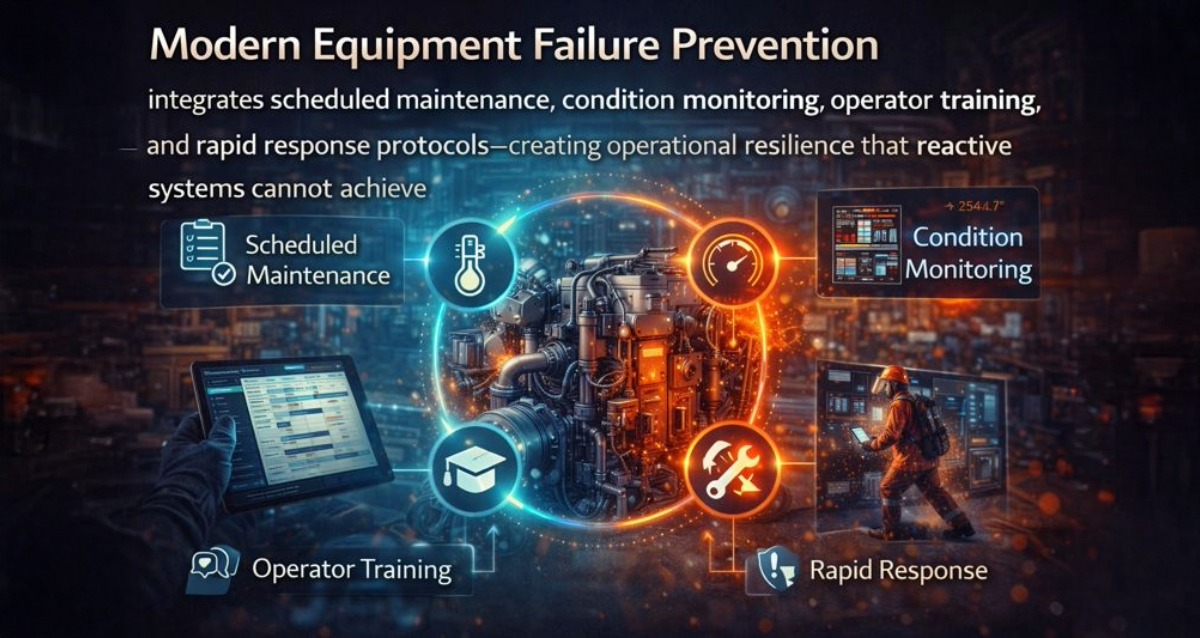
 Preventive maintenance for industrial equipment
This scenario unfolds in industrial facilities worldwide. Not once. Repeatedly. Predictably.
But here’s the operative word: predictably.
Equipment doesn’t fail randomly. It deteriorates visibly, measurably, communicatively—if anyone is listening. The breakdown you experienced at 3 AM was written into vibration frequencies three months earlier. It was encoded in temperature patterns six weeks before that. It lived in spare part consumption data for the entire fiscal year.
The crisis wasn’t unpredictable. It was unmonitored.
The Architecture of Invisible Costs
When equipment fails unexpectedly, the financial damage extends far beyond the repair invoice. Most organizations capture only 20-30% of the true cost. The rest bleeds through gaps that spreadsheets don’t track.
Direct Repair Costs: Emergency labor rates run 1.5–2x standard wages. Expedited parts shipping costs 3–7x ground delivery. Rush diagnostic services command premium fees. A $15,000 planned repair becomes $45,000 under emergency conditions.
Production Loss: For manufacturers, lost output represents 80% of total downtime cost. In automotive production, a single hour of unplanned downtime costs $1.3 million in lost revenue. In pharmaceutical operations, one facility shutdown can cost $5–$10 million. Even small batch operations hemorrhage cash: 500 units not produced at $50 each represents $25,000 in lost revenue—before accounting for the customer penalties for missed delivery dates.
Collateral Damage: Equipment doesn’t fail in isolation. When a primary pump fails, vibration travels through connected systems. Stress cascades to gearboxes, bearings, electrical controllers. What began as a $50,000 repair balloons into $180,000 when adjacent equipment is damaged in the cascade.
Supply Chain Disruption: Your facility isn’t an island. When you miss production, your customers adjust. They source alternatives. They negotiate volume penalties. They reduce future orders. Studies show that three unplanned outages in six months can cost 15-25% in repeat business from major accounts.
Human Cost: Technicians working under emergency pressure cut corners on safety procedures. Overtime extends fatigue. The stress manifests in error rates that compound problems. One automotive manufacturer tracked a 3.2x increase in secondary equipment failures following emergency repairs performed under time pressure.
Compliance and Regulatory Risk: Every unplanned failure creates a record. Insurance claims rise. Regulatory inspections deepen. Environmental incidents during emergency repairs carry fines. Occupational safety violations from inadequate emergency procedures cascade into legal exposure.
The true cost of that 3 AM failure wasn’t $407,700. It was closer to $680,000—when you calculate the three delayed customer shipments, the supply chain renegotiations, the corrective action documentation required by your compliance officer, and the reputation damage from missing your Q2 targets.
What Breakdown Maintenance Actually Is (And Why It’s Winning)
Breakdown maintenance—also called reactive or run-to-failure maintenance—isn’t a strategy. It’s the default. It’s what happens when you respond to emergencies instead of preventing them.
Think of it this way: You own a house. You never service the roof. You never inspect the foundation. You never maintain the HVAC system. You wait until the roof leaks during a rainstorm, the foundation cracks during winter freeze, the air conditioning fails in July heat. Then you call emergency contractors at premium rates.
Breakdown maintenance is that exact model, applied to machinery worth millions.
Here’s how it operates in practice: Equipment runs until it stops. Operators notice the failure—sometimes minutes after it occurs, sometimes hours. Maintenance is called. Parts are sourced (often with expedited shipping). Technicians arrive and diagnose. Repairs commence, frequently extending into nights and weekends. Operations resume.
The appeal is obvious: Zero maintenance costs until failure. No scheduled downtime. No preventive spending. It feels fiscally efficient.
Until it isn’t.
The Japanese concept of mottainai—the profound waste of resources—describes what actually happens. Yes, you save the $8,000 quarterly maintenance contract. But you spend $45,000 reacting to the failure that contract would have prevented. You think you’ve gained $8,000 while actually losing $37,000.
The paradox explains why breakdown maintenance persists in organizations that can least afford it. Under-resourced maintenance departments, cost-pressured facilities, and operations running on inherited systems often have no alternative. Breakdown maintenance isn’t chosen—it’s endured.
But here’s what changes everything: Visibility.
Three Breakdown Archetypes (And When They Actually Happen)
Not all equipment failures are identical. Understanding the mechanics reveals when breakdown maintenance transforms from cost-cutting into catastrophic risk.
Type 1: The Wear-Out Failure
Equipment deteriorates predictably. Bearings accumulate friction-induced wear. Seals lose elasticity. Electrical components degrade under thermal stress. The failure curve is well-established: equipment operates reliably for 70% of its lifespan, then enters a degradation phase where failure risk accelerates exponentially.
A textile mill’s spinning frame fails after 8,000 operating hours. The bearing temperature has been rising for 200 hours. Vibration amplitude doubled in the prior 100 hours. The sound signature changed 60 hours before failure. Every indicator was present.
Planned maintenance at 7,500 hours costs $6,200. Emergency replacement at 8,000 hours costs $28,000, plus $340,000 in lost production.
Type 2: The Unexpected Shock Failure
Power surges destroy electrical components instantly. Contamination—dust, water, particulates—enters systems and causes abrupt failure. Metal fatigue finally exceeds material tolerance. These failures arrive without warning.
Except they do have warnings. The electrical surge occurred because maintenance hadn’t updated surge protection per 2022 equipment specifications. The contamination entered because seal inspection was deferred for six months. The metal fatigue accelerated because load calculations assumed lighter production schedules—contradicted by actual operation running 15% above design capacity.
Shock failures look unpredictable. They’re actually predictable by failure mechanism analysis.
Type 3: The Cascading Failure
Equipment A fails. Because A isn’t maintained, related equipment B experiences compensatory stress. B fails earlier than planned. C follows. Within 60 days, half the production line is offline.
A ceramic manufacturer experienced this cascade: The primary drying kiln experienced thermal stress from deferred maintenance. Temperature control degraded. Material consistency shifted. The adjacent molding equipment compensated by running hotter. Within three weeks, the molding equipment’s electrical control system failed from thermal stress. The subsequent production line restart revealed that four connected systems had suffered degraded performance.
The initial kiln maintenance cost $18,000. The cascade cost $340,000 in downtime, replacement equipment, and rework.
Real Evidence Across Industries
The theory matters less than the pattern. Across diverse sectors, the data is unambiguous.
Manufacturing: Global Fortune 500 manufacturers lose 323 production hours annually per major plant—costing $532,000 per hour in lost revenue, penalties, and idle labor. That’s $172 million in annual losses per plant. Extrapolated across major industrial operations, manufacturers lose $864 billion yearly to unplanned downtime.
For context: That’s 8% of Fortune 500 manufacturing revenues. It’s not a cost center issue. It’s a business model vulnerability.
Automotive: The sector experiences the highest downtime frequency—29 hours per month at $1.3 million per hour. Annual loss: $557 billion across FG500 automotive companies. Individual plant managers report 20-25 breakdown events monthly.
Oil and Gas: Refineries face 32 hours of unplanned downtime per month, costing $220,000 per hour. Sector-wide: $84 million per facility, annually.
Heavy Industrial and Mining: 23 hours per month of unplanned downtime at $187,500 per hour—$225 billion annually across major enterprises.
Facilities and Infrastructure: UK and European manufacturers alone face £80 billion in unplanned downtime costs in 2025. Commercial real estate portfolios lose $50,000+ per facility annually to deferred maintenance creating emergency repairs.
Pharmaceutical: Regulatory downtime is catastrophic. One major incident costs $5–$10 million. Compliance investigations extend timelines by months.
The variance across industries isn’t random. It reflects downtime cost per hour—which correlates directly with asset value, production speed, and customer contract penalties.
The commonality: Breakdown maintenance dominates in cost-conscious operations, and costs continue accelerating.
The Strategic Shift: From Firefighting to Forecasting
Here’s what separates resilient operations from perpetually disrupted ones: Preventive maintenance fundamentally changes the cost structure.
Instead of reacting to failures, you schedule maintenance based on equipment condition, manufacturer specifications, and historical performance data. You stop waiting for the breakdown. You intercept it.
The numbers are stark:
-
Prevention ROI: Every $1 spent on preventive maintenance generates $5.45 in return through avoided repairs and reduced downtime.
-
Cost Reduction: Organizations implementing preventive maintenance reduce repair costs by 30% while extending asset lifespan by 20%.
-
Downtime Reduction: Planned maintenance reduces unplanned downtime by 50-75% compared to reactive operations.
-
Labor Efficiency: Standard-hour technician labor costs $80/hour. Emergency technician labor costs $120–$160/hour. Prevention uses standard labor.
A hospital chain implemented computerized maintenance management (CMMS) software across their medical equipment fleet. Before: 15 hours average downtime per month, $260 cost per work order, 70% SLA compliance. After: 4 hours downtime per month, $170 cost per work order, 95% SLA compliance. Annual maintenance spend dropped from $1.2 million to $900,000.
The transformation wasn’t complex. It required three shifts:
First: Visibility. Track every piece of equipment. Record every failure, repair, and maintenance action. Build a historical database. Equipment tells stories through data—when it received the most repairs, what conditions preceded failures, which components age fastest. Operators and technicians live in this data. They see patterns humans can’t see in isolation.
Second: Planning. Replace reactive dispatching with scheduled interventions. Instead of “fix it when it breaks,” you execute “service it on Tuesday at 2 PM based on operational history.” You order parts before you need them. You schedule technicians during planned downtime, not emergency hours. You prevent cascading failures by addressing root causes before secondary equipment compensates.
Third: Intelligence. Modern systems integrate sensor data, historical records, and predictive algorithms. Equipment temperature rising? The system flags it. Vibration amplitude increasing? Alert triggered. Spare parts consumption pattern changing? Recommendation surfaces. You’re no longer reacting to failures. You’re forecasting them.
What The Winning Operations Don’t Tell You
The maintenance literature celebrates the ROI of preventive approaches. What it rarely acknowledges: preventive maintenance has real limitations, and certain failure modes still escape even the best systems.
The Data Problem: Predictive maintenance requires 6–12 months of baseline data before accuracy approaches 85–95%. Facilities with recent equipment, legacy systems without sensors, or rapidly changing operations can’t collect sufficient historical data. You’re flying partially blind initially.
The Complexity Tax: Shifting from reactive to preventive requires investment upfront. CMMS software costs $50–$110 per user per month. Sensor implementation costs $15,000–$50,000 for a mid-sized facility. Staff training extends timelines. The ROI is real but appears 12–18 months post-implementation. Organizations with acute cash constraints can’t absorb the transition cost.
The Obsolescence Risk: You schedule maintenance based on historical failure patterns. But if you’ve changed production speed, product mix, environmental conditions, or operator procedures, historical patterns become misleading. You’re maintaining for yesterday’s operation while running today’s.
The Unpredictable Shock: Some failures arrive without warning. Sudden electrical surges. Instantaneous metal fatigue. External contamination events. No amount of monitoring prevents these. You can only respond.
The Equipment Ceiling: Old equipment—especially legacy industrial machinery—was designed before sensor integration became standard. Adding retrofit sensors is expensive and imprecise. You’re applying modern maintenance strategy to equipment that doesn’t speak modern machine language.
The Human Factor: Maintenance schedules only work if executed. Equipment still fails when technicians defer maintenance because production is behind schedule, budget cycles limit spending, or organizational priorities shift. The best system cannot overcome organizational dysfunction.
What separates exceptional operations from struggling ones isn’t perfect maintenance. It’s the willingness to acknowledge these limitations and design around them. They implement preventive maintenance for critical assets (where ROI is highest), maintain reactive capability for non-critical equipment, and continuously adapt as conditions change.
The Emerging Framework: Intelligent Maintenance Systems
Where maintenance strategy is heading, organizations are preparing now.
Predictive Maintenance Ascendancy: By 2026, predictive maintenance (leveraging real-time sensor data, machine learning, and historical analysis) will become standard across capital-intensive operations. Instead of “maintain on schedule,” the directive becomes “maintain when condition indicates imminent failure.” Cost reduction reaches 18–25% beyond preventive approaches. Unplanned downtime drops 30–50% compared to time-based maintenance.
Digital Twin Integration: Virtual equipment replicas—powered by real-time operational data—allow teams to simulate maintenance scenarios, test failure responses, and optimize intervention timing without affecting actual production. Maintenance planning time drops 50–70%.
AI-Enabled Decision Support: Machine learning models analyzing millions of sensor data points detect failure patterns invisible to human analysis. Systems recommend optimal maintenance timing, spare parts procurement, and resource allocation. Prediction accuracy reaches 85–95% with adequate training data.
Supply Chain Synchronization: Maintenance systems no longer operate in isolation. They integrate with inventory management, procurement, production scheduling, and customer commitment systems. When condition indicates a bearing replacement is needed in 72 hours, the system automatically orders the part, schedules the technician, adjusts production planning, and notifies customers of potential timing considerations.
Autonomous Maintenance: Self-monitoring systems detect issues and either self-correct (automated lubrication systems, pressure valve adjustments) or issue definitive maintenance requests with high confidence. Human technicians focus on complex diagnostics and major repairs instead of routine checks.
Sustainability Integration: Maintenance decisions now account for environmental impact. Extending equipment life through preventive maintenance reduces manufacturing waste. Predictive approaches reduce energy consumption by preventing inefficient equipment operation. Maintenance carbon footprints are tracked and optimized.
For organizations today, the strategic question isn’t “Do we implement preventive maintenance?” That’s table stakes. The question is “How do we layer intelligence, automation, and predictive capability into our maintenance operations to achieve advantages competitors cannot easily replicate?”
The Mathematics of Intelligence
A mid-sized manufacturing facility with $80 million in annual revenue typically spends 3–4% of revenue on maintenance ($2.4–$3.2 million annually). Under breakdown-dominant operations, 70% of maintenance spend is reactive emergency work. That’s $1.68–$2.24 million yearly in high-cost crisis response.
A shift to 50% preventive, 30% predictive, 20% reactive operations costs $200,000 to implement (CMMS, sensors, training) and restructures the $2.4M annual budget:
-
Preventive maintenance: $1.2M (standard costs)
-
Predictive monitoring: $300K (sensor maintenance, data analysis)
-
Reactive response capacity: $480K (emergency capability reduced but maintained)
-
ROI: $1.2M–$1.4M in annual savings through:
-
Eliminated expedited shipping ($450K)
-
Reduced emergency labor premiums ($350K)
-
Extended equipment lifespan ($280K in deferred replacements)
-
Production continuity ($400K in avoided penalties)
-
Payback period: 2–4 months.
Twenty-four months in, cumulative benefit: $2.4–$3.2 million.
This isn’t theoretical. This is documented across sectors and scales. The question isn’t whether prevention works. The question is why any organization operates otherwise.
A First-Hand Case: When Visibility Changed Everything
A precision component manufacturer in the Midwest operated with 65–70% reactive maintenance for fifteen years. Equipment broke. Technicians fixed it. Production resumed. The cycle was predictable, if expensive.
The shift came not from strategy but from crisis. A critical production line failed during their largest seasonal order period. The repair took 18 hours. Production missed the delivery window by 36 hours. The customer—representing 22% of annual revenue—issued a contractual penalty ($280,000) and notified the supplier they would be seeking alternatives.
In the weeks following, management calculated what that failure actually cost: $780,000 including repair, downtime, penalty, and subsequent relationship recovery effort.
They implemented a CMMS system and basic sensor monitoring on critical assets. Cost: $185,000 plus six weeks of implementation disruption.
In the first eight months, the system identified fourteen equipment degradation patterns requiring maintenance intervention. Thirteen were addressed during planned downtime. The fourteenth (a compressor bearing temperature trend) was caught three days before predicted failure—enabling emergency intervention during scheduled facility shutdown.
Eighteen months in:
-
Downtime dropped 52% ($1.2M avoided
-
Equipment repair costs fell 38% ($680K savings)
-
The customer relationship stabilized and expanded
-
Maintenance staff shifted from crisis mode to strategic planning
The facility manager reflected: “We weren’t unlucky with the failure. We were blind to what was happening. The equipment was screaming for months. We just didn’t know the language.”
The Indian Context: When Margins Are Razor-Thin
In a tier-2 textile manufacturing facility in central India, the situation played differently—but with identical underlying mechanics.
The facility operated with inherited machinery, tight margins, and cost pressures that made preventive maintenance feel like unaffordable luxury. Breakdowns were managed through local technician networks and rapid parts improvisation. Production was maintained through operator skill and determination.
Until the drying kiln—the facility’s most critical asset—failed mid-cycle. The repair required components that took two weeks to source. Production halted. Customer orders were missed. The financial impact threatened the family business model that had sustained the operation for three decades.
The recovery required external capital: A technology partner implemented a modest CMMS system (₹8 lakh investment) and trained the team on structured maintenance planning.
What changed wasn’t the technology sophistication. It was the operational discipline. Every breakdown was now documented. Failure patterns became visible. The team could distinguish between random failures and systematic degradation.
Within six months, planned maintenance replaced crisis management. The drying kiln’s maintenance shifted from reactive fixes to quarterly scheduled interventions. Other equipment followed.
The facility’s margin pressure actually eased—counterintuitively—because the hidden cost of breakdowns ($45,000–$85,000 per incident) was eliminated. What looked like overhead (maintaining systems) revealed itself as profit recovery (preventing losses).
The facility manager shared this learning: “In India, we assume we cannot afford to be proactive. But breakdown culture is more expensive than everyone realizes. It’s just that the cost is distributed—delayed shipments, customer penalties, overtime payments—so nobody sees it concentrated.”
Three Questions Worth Asking
As you evaluate your own operation, these questions cut through the noise:
First: Can you identify your true downtime cost per hour? If you’re like most organizations, you can’t. You know direct production loss. Do you account for supply chain disruption, customer penalties, remediation costs, compliance impacts? If you can’t calculate it, you’re underestimating the value of prevention by 300–400%.
Second: What percentage of your maintenance spend is reactive versus planned? Above 50% reactive suggests you’re operating in crisis mode. Above 70% reactive means downtime is likely a consistent competitive disadvantage. Where are you?
Third: If you could reduce downtime by 50% without increasing maintenance budget, what would change in your business? That’s not hypothetical. Organizations implementing preventive strategies achieve exactly that. What would you do with $500K–$2M in recovered production capacity?
A Reframing for Decision-Makers
The traditional maintenance conversation centers on cost: “How do we minimize maintenance spending?”
That’s the wrong question.
The right question is: “How do we maximize equipment availability while optimizing total maintenance investment?”
Those are fundamentally different objectives. The first leads to breakdown culture. The second leads to intelligent maintenance strategy.
Equipment is not a cost center. It’s a revenue engine. When it stops, revenue stops. The maintenance decision isn’t “How much do we spend?” It’s “What investment prevents the largest revenue interruptions?”
From that perspective, prevention isn’t optional. It’s foundational.
The Path Forward
The organizations winning in competitive markets aren’t winning on product alone. They’re winning on reliability. They’re winning on ability to meet commitments. They’re winning on operational predictability.
Breakdown maintenance is not a strategy. It’s the temporary state before strategy arrives.
The shift from reactive to preventive isn’t complex. It requires three things: (1) Systems that create visibility into equipment condition, (2) Discipline to act on that visibility through planned intervention, and (3) Leadership commitment to prioritize reliability over short-term cost minimization.
Most facilities have the capability today. Many have the technology. Few have completed the organizational transition.
That transition—from firefighting to forecasting—is the most valuable maintenance decision an operation can make.
The question isn’t whether prevention works. The question is when you begin.
Reflection Questions
-
What would happen to your operation if your primary production equipment failed today?
-
How much of that impact is actually preventable through better visibility and maintenance planning?
-
What hidden downtime costs are you currently absorbing that organized maintenance could recover?
The answers might transform how you think about maintenance investment.
References
Emergency labor rates premium analysis across industrial sectors
Automotive downtime cost per hour, Fortune 500 manufacturing study
Preventive maintenance ROI, Jones La Salle Study
Cost reduction and asset lifespan extension through preventive maintenance
Planned maintenance downtime reduction effectiveness
Hospital CMMS implementation results, case study data
Predictive maintenance accuracy requirements and timelines
Predictive maintenance cost reduction vs preventive
Unplanned downtime reduction through predictive approaches
Digital twin maintenance planning efficiency
AI prediction accuracy thresholds
Must utilize Resources
“Together, We Keep It Alive”
Words find meaning when hearts stay connected.
If this reflection reached you, your small act of support keeps the light of shared purpose alive.
Please write to us at dinabinamarigold@gmail.com for an invoice, if required.