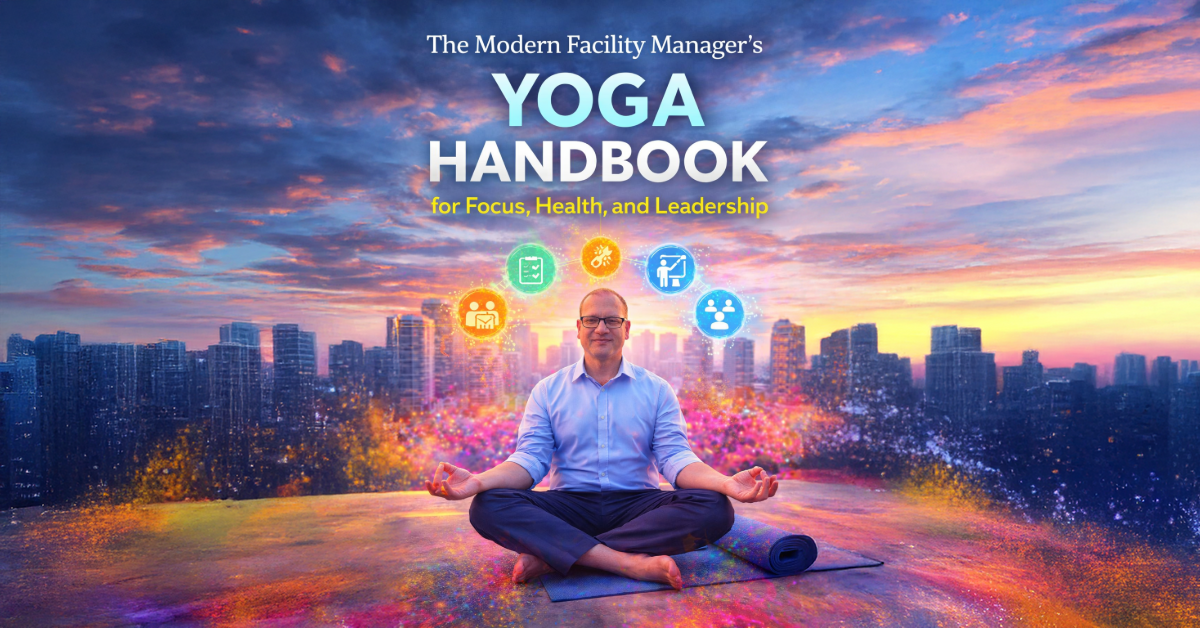
🏢🧘 From Overwhelmed to Optimized: The Facility Manager’s Complete Yoga Protocol for Peak Performance, Cardiovascular Health, and Unshakeable Calm
“The quietest person in the building carries the loudest responsibilities. For a facility manager, wellness isn’t a luxury — it’s infrastructure.”
Introduction: The Invisible Weight of Managing Everything

It’s 7:04 AM. Before your first coffee cools, you’ve fielded three maintenance alerts, received a compliance escalation from the safety officer, responded to a vendor delay, and mentally rescheduled an afternoon walkthrough because a pipe has burst on the third floor.
Slow Breath, Steady Heart: A Yogic Blueprint to Lower Blood Pressure Fast
Nobody sees it. Nobody talks about it. But the facility manager — the person who holds the physical, operational, and safety architecture of an entire building together — is quietly burning out.
Nearly two-thirds of working professionals report high levels of workplace stress, and facility managers, with their uniquely multi-layered responsibilities, sit squarely in the highest-risk category. According to current wellness data, 56% of employees experienced burnout within the last 12 months, while companies with mindfulness-integrated wellness programs report a 25% reduction in stress-related absenteeism.
The question isn’t whether stress is affecting your performance. The question is: what are you going to do about it?
The answer — ancient, accessible, and now powerfully backed by modern science — is yoga. Not the Instagram kind. Not the 90-minute retreat kind. But a precise, targeted, time-efficient protocol engineered specifically for the physical and cognitive demands of facility management — one that also addresses a dangerous silent risk: elevated blood pressure.
This blog post is your complete blueprint.prkglobal360prkglobal360
A facility professional navigating the complex demands of building operations — a role that demands both physical endurance and sharp mental acuity.
The Facility Manager’s Body Under Siege: Understanding the Real Cost of the Role

Facility managers don’t sit still. They pace corridors, climb stairwells, crouch beside HVAC units, stand through hour-long vendor briefings, and then sit at a desk processing compliance documentation for another three hours. This combination of sedentary desk work, sudden physical exertion, and unrelenting cognitive demand creates a uniquely destructive physiological cocktail.
The result: chronic muscular tension (particularly in the lower back, shoulders, and neck), elevated cortisol levels, and — critically — persistently elevated blood pressure. According to a 2025 meta-analysis published in PubMed, pranayama (yogic breathing) significantly reduces heart rate (SMD = -0.43) and systolic blood pressure (SMD = -0.72) across clinical populations.
High blood pressure isn’t just a health statistic. For a professional responsible for the safety of an entire building and its occupants, it’s a performance issue. Cognitive sharpness, emotional regulation, and rapid decision-making — the core competencies of elite facility management — all degrade under hypertension.
The good news? 12 weeks of yoga-based slow breathing can produce clinically significant blood pressure reduction — without medication, without side effects, and without expensive interventions.
The facility management role requires constant collaboration, quick decision-making, and physical presence — all of which are compromised under chronic stress.
The Science That Changes Everything
For years, yoga was dismissed in professional circles as soft wellness theatre. That narrative is now scientifically obsolete.
A landmark study tracking 99 participants over 12 weeks confirmed that slow breathing exercises — the core of pranayama — produced clinically significant reductions in both systolic and diastolic blood pressure. A separate University of Missouri study found that 54% of participants with uncontrolled high blood pressure lowered their readings by at least 5 points through yogic breathing alone, even when medication had previously failed to achieve the same outcome.
What’s happening biologically? Slow, controlled breathing — particularly techniques like Anulom Vilom (Alternate Nostril Breathing) — activates the parasympathetic nervous system, counteracting the fight-or-flight stress response that floods the body with cortisol and adrenaline. For a facility manager who spends much of the workday in a state of low-grade emergency readiness, this neurological reset is not optional — it’s essential.
Key Insight: Yoga doesn’t just make you feel calmer. It biologically recalibrates your cardiovascular system, autonomic nervous system, and hormonal balance — making you objectively more resilient under pressure.
The Yoga Protocol: 7 Precision Asanas for Facility Managers
These aren’t generic poses pulled from a beginner’s class. Each asana below is selected for its direct application to the physical and cognitive demands of facility management — and each targets specific physiological systems that are documented to degrade under occupational stress.
1. Tadasana (Mountain Pose): The Power Reset

Duration: 2–3 minutes | Best Time: Before site walkthroughs or high-stakes meetings
Tadasana is deceptively simple — and profoundly effective. Standing in perfect vertical alignment with feet grounded, spine elongated, and breath deep and deliberate, this pose directly counteracts the forward-head posture and shoulder collapse that come from hours at a desk or bent over inspection reports.
The deep diaphragmatic breathing in Tadasana activates the vagus nerve — the body’s primary parasympathetic pathway — reducing cortisol levels and creating the mental clarity that precedes excellent decision-making. Think of it as rebooting your operating system before a critical task.
Facility Management Application: Practice Tadasana for 2 minutes before entering any high-pressure meeting. The physiological grounding it provides measurably improves your composure and communication presence.
Tadasana — the Mountain Pose — builds postural integrity, grounds the nervous system, and prepares the mind for high-performance focus.
2. Vrikshasana (Tree Pose): The Multitasker’s Anchor

Woman in tree pose (Vrikshasana) on rocky seaside cliff at sunset dreamstime
Duration: 30–60 seconds per side | Best Time: Mid-morning focus break
Vrikshasana demands full neurological attention. Balancing on one leg while maintaining a relaxed upper body forces your brain to consolidate focus, quiet internal chatter, and activate the cerebellum and prefrontal cortex simultaneously.
For a facility manager who must mentally track five concurrent workstreams — a HVAC repair timeline, a safety audit, a vendor negotiation, a staffing roster change, and a budget variance — the discipline of single-pointed attention developed in Vrikshasana translates directly into professional cognitive efficiency.
Facility Management Application: Use this pose during a 5-minute break between task shifts to mentally “clear the cache” and return to the next responsibility with renewed sharpness.
Vrikshasana cultivates the mental stillness and balanced concentration that facility managers need to navigate complex, multi-threaded responsibilities.
3. Bhujangasana (Cobra Pose): The Spine Protector
Duration: 3–5 breaths, held | Best Time: Post-inspection recovery
When you spend part of your day crouching beneath equipment panels, bending to examine floor-level infrastructure, or hunching over a laptop, the lumbar spine compresses and the thoracic spine rounds. Over months and years, this produces chronic back pain — one of the leading causes of occupational sick days globally.
Bhujangasana reverses this. By actively extending the spine, opening the chest, and engaging the posterior musculature, the Cobra Pose decompresses the lumbar vertebrae, improves intervertebral disc health, and opens the respiratory cavity for fuller, more oxygenated breath.
Facility Management Application: Perform Bhujangasana on a small yoga mat in your office after any extended site inspection. Three repetitions take under 4 minutes and prevent the cumulative spinal damage that sidelines professionals for weeks.
4. Setu Bandhasana (Bridge Pose): The Core Fortress
Duration: 5–8 breaths, 3 repetitions | Best Time: Morning activation routine
Bridge Pose builds the deep core and gluteal stability that supports every physical task in facility management — from climbing ladders to standing through multi-hour safety briefings. Beyond muscular strength, Setu Bandhasana stimulates the thyroid gland, regulates metabolism, and — crucially — activates the parasympathetic nervous system, contributing to measurable blood pressure reduction.
A strong core is not about aesthetics. For a facility manager, it’s operational infrastructure. Core weakness contributes to lower back injuries, poor posture, fatigue, and reduced endurance during physically demanding site management days.
Facility Management Application: Include 3 repetitions of Bridge Pose in your morning routine before leaving home. The 6-minute investment pays dividends across the entire workday.
5. Balasana (Child’s Pose): The Decompression Chamber
Duration: 1–3 minutes | Best Time: Post-crisis decompression
After a genuine operational crisis — a fire alarm activation, a flooding incident, a compliance breach — the adrenal system needs active recovery, not passive waiting. Balasana places the body in a position of total neurological safety: forehead grounded, spine rounded gently, arms extended, breath slow.
This posture directly downregulates the sympathetic nervous system (fight-or-flight) and activates parasympathetic recovery (rest-and-digest). The effects on blood pressure are immediate — cortisol begins to clear, heart rate drops, and the prefrontal cortex (the rational, strategic thinking brain) reasserts dominance over the amygdala.
Facility Management Application: Keep a small, foldable yoga mat in your office. Two minutes of Child’s Pose after any crisis will restore your cognitive baseline faster than coffee, sugar, or scrolling will.
6. Adho Mukha Svanasana (Downward Dog): The Full-System Refresh
Duration: 5–7 breaths | Best Time: Afternoon energy slump
The 3 PM energy crash is a physiological event, not a character flaw. Blood pools, circulation slows, and cognitive function dips. Downward Dog inverts the torso partially, sending oxygenated blood to the brain, stretching the entire posterior chain (calves, hamstrings, spine, shoulders), and generating a full-body energy refresh.
For facility managers who need to maintain alertness from early morning site inspections through late-afternoon administrative work, this pose is a caffeine-free performance enhancer.
Facility Management Application: Replace afternoon coffee with 60 seconds of Downward Dog. The circulation boost is immediate, and the energy return lasts 45–60 minutes.
7. Anulom Vilom (Alternate Nostril Breathing): The Blood Pressure Master Switch
Duration: 5–10 minutes | Best Time: Morning, pre-meeting, or crisis recovery
This is the crown jewel of the protocol — and the most directly relevant to the urgent cardiovascular health challenge facing high-stress professionals.
Anulom Vilom (inhaling through one nostril while closing the other, then alternating) creates a balanced, rhythmic breath pattern that activates both hemispheres of the brain, balances the autonomic nervous system, and — according to a 2026 PubMed meta-analysis of seven randomized controlled trials — significantly reduces heart rate (SMD = -0.43) and systolic blood pressure (SMD = -0.72).
The mechanism is elegant: slow, controlled exhalation (longer than inhalation) activates the vagus nerve and triggers a parasympathetic cascade that directly lowers vascular resistance, reduces cardiac output, and normalizes arterial pressure. A 12-week daily practice produces results comparable to low-dose antihypertensive intervention — without side effects.
This is not wellness metaphor. This is quantified, peer-reviewed, cardiovascular medicine.
Facility Management Application: Practice 5 minutes of Anulom Vilom every morning before reviewing the day’s schedule. Build to 10 minutes over four weeks. Monitor blood pressure monthly — the data will motivate you to continue.
Anulom Vilom pranayama — science-confirmed to lower blood pressure, regulate the autonomic nervous system, and create deep cognitive calm within minutes of practice. Rishikulyogsrishikulyogs
Group pranayama practice builds a shared culture of wellness — facility teams that breathe together, perform together.
The 15-Minute Daily Protocol: Complete Weekly Blueprint
This isn’t a 90-minute yoga retreat. It’s a precision tool.
| Day | Morning (10 min) | Midday (3 min) | Evening (5 min – Optional) |
|---|---|---|---|
| Monday | Anulom Vilom (5 min) + Tadasana (3 min) + Setu Bandhasana (2 min) | Vrikshasana (1 min each side) | Balasana decompression |
| Tuesday | Anulom Vilom (5 min) + Bhujangasana (3 min) + Downward Dog (2 min) | Neck rolls + shoulder stretch | Child’s Pose |
| Wednesday | Anulom Vilom (7 min) + Tadasana (3 min) | Vrikshasana balance reset | Setu Bandhasana |
| Thursday | Full sequence: all 7 poses (15 min) | Seated spinal twist | Anulom Vilom |
| Friday | Anulom Vilom (5 min) + Bhujangasana + Bridge | Chair-based forward fold | Balasana |
| Saturday | Extended practice (20 min, all poses) | — | Meditation (10 min) |
| Sunday | Rest or gentle Balasana only | — | Gratitude breathwork |
How This Protocol Transforms Professional Performance: Evidence-Based Outcomes
Sharper Decision-Making Under Pressure
Chronic stress floods the brain with cortisol, which physically shrinks the prefrontal cortex — the region responsible for strategic thinking, impulse control, and risk assessment. Regular pranayama practice reverses this cortisol accumulation, restoring prefrontal cortex volume and function. A facility manager with a regulated nervous system makes faster, better decisions during emergencies — not because they’re calmer personalities, but because their neurobiology supports clearer thinking.
Fewer Sick Days and Lower Healthcare Costs
Workplace wellness programs incorporating mindfulness and yoga report a 25% reduction in stress-related absenteeism. For facility management teams, where a single manager’s absence can cascade into operational chaos, this is a significant organizational advantage. The investment in a yoga mat pays dividends measured in uninterrupted operational continuity.
Cardiovascular Protection Against the Silent Killer
Elevated blood pressure is asymptomatic until it isn’t. Hypertension causes no pain, no warning, and no performance decline you’d notice — until the stroke or cardiac event it precipitates forces an emergency. For high-stress professionals, the 12-week pranayama protocol described in current clinical research offers verifiable, measurable cardiovascular protection as an accessible, cost-free daily practice.
Enhanced Team Leadership and Communication

Mindfulness practices — including yoga — demonstrably improve emotional regulation, empathy, and active listening. For a facility manager who must simultaneously manage contractor teams, address tenant complaints, liaise with senior building ownership, and motivate maintenance staff, these interpersonal competencies are as operationally critical as any technical skill.
Office-adaptive yoga poses can be practiced at a workstation — making the protocol accessible even within the most demanding operational schedule.
The Blood Pressure Connection: Why Facility Managers Must Act Now
Workplace stress and blood pressure are not loosely correlated — they are mechanically linked. Chronic stress triggers sustained sympathetic nervous system activation, which constricts blood vessels, elevates cardiac output, and drives blood pressure upward. Over months and years, this produces structural vascular damage that is difficult to reverse.
The yogic solution targets this mechanism at its source: slow exhalation-dominant breathing (where the exhale is longer than the inhale, as in Anulom Vilom’s E>I ratio) has been clinically shown to directly activate the baroreflex — the body’s primary blood pressure regulatory system — producing sustained reductions in both systolic and diastolic pressure.
A 2025 study published by the National Institutes of Health confirmed these findings across 99 healthy participants: the E>I (exhale-greater-than-inhale) breathing pattern produced the most significant autonomic benefits, suggesting that the quality and ratio of your breath matter as much as the duration of practice.
For further in-depth reading on yogic breathing and cardiovascular health, this detailed resource on Slow Breath, Steady Heart: A Yogic Blueprint to Lower Blood Pressure provides an excellent companion guide to the protocol described here.
“The quieter you become, the more you are able to hear.” — Rumi
Principles, Process, Proof: The Three Pillars of a Yoga-Powered Career
Principles
Yoga is not a supplement to facility management excellence — it is its physiological foundation. The principles are simple: a regulated nervous system outperforms a reactive one. A healthy cardiovascular system sustains peak performance longer. A mindful professional communicates better, decides faster, and leads more effectively.
Process
The process is the 15-minute daily protocol above — consistent, progressive, and adaptive. Start with Anulom Vilom and Tadasana in week one. Add Bhujangasana and Setu Bandhasana in week two. By week four, the full protocol becomes as automatic as your morning alarm.
Proof
The proof arrives in week eight: your morning blood pressure readings drop. Your team notices you’re more measured in crisis moments. You haven’t taken a sick day. Your end-of-day fatigue is reduced by the afternoon breathwork. The building runs better because its manager is running better.
Actionable Tips: Getting Started This Week
- Download a breath timer app (like Prana Breath or iBreathe) to guide your Anulom Vilom practice — the rhythm matters
- Place a small yoga mat in your office or locker room — physical access removes the #1 barrier to practice
- Set a phone alarm at 3 PM labeled “Downward Dog” — treat it like a meeting with yourself
- Track blood pressure weekly with a home monitor — objective data sustains motivation
- Practice Balasana immediately after any operational crisis — make it a post-incident protocol, not an occasional retreat
- Share this protocol with your maintenance team — a wellness culture starts from the toprecruiterslineup
- Use Vrikshasana as a pre-briefing focus ritual — 60 seconds of balance training sharpens cognitive attention for the subsequent task
Conclusion: The Building’s Most Important System Is You
The most sophisticated HVAC system fails without proper maintenance. The most advanced access control platform degrades without regular calibration. And the most capable facility manager in the world underperforms when their cardiovascular health, nervous system regulation, and mental clarity are neglected.
Yoga isn’t a wellness hobby. For facility managers, it is occupational maintenance — as essential as the CMMS software, the safety compliance checklist, and the emergency response plan.
Fifteen minutes a day. Seven targeted practices. Twelve weeks to measurable cardiovascular change. One career transformed.
Start tomorrow morning with five minutes of Anulom Vilom before you check your phone. Before you read the overnight maintenance log. Before the demands of the building claim your attention. Five minutes of breath — exhale longer than you inhale — and the science confirms: your heart rate will slow, your blood pressure will soften, and your mind will sharpen.pubmed.ncbi.nlm.nih+1
The building needs you at your best. That starts with breathing well.
Facilities Manager Stress Crisis: The Complete Wellness Fix
👇 Have you tried yoga as part of your professional wellness routine? Share your experience in the comments — your story might inspire the facility manager who needs it most. And if this post gave you value, share it with a colleague in building management who deserves to read it.
A True Story (Name Withheld)
A senior facility manager at a large IT campus in Pune was managing over 12 floors, 800 daily occupants, and a team of 40 maintenance workers. By age 44, his blood pressure had crept to 148/96. His mornings were reactive — phone in hand before feet hit the floor, operational alerts before breakfast, cortisol spiking before the day formally began.
A colleague quietly suggested a 10-minute morning pranayama practice. Skeptical, he tried Anulom Vilom for five minutes before opening his phone each morning — for one week. The second week became ten minutes. By week six, he added Bhujangasana after his afternoon inspections.
At his next health checkup in week ten, his doctor noted his blood pressure had dropped to 131/85. His resting heart rate fell by eight beats per minute. He hadn’t changed his diet or his schedule. He had only changed his breath.medicine.missouri+1
The lesson he shared with his team: “We maintain every system in this building on a preventive schedule. I was the only critical system running without one.”
He now leads a 10-minute group pranayama session every Friday morning for his operations team. Absenteeism in his department dropped by 30% in the following quarter. recruiterslineup
📌 If you found value in this post, share it, bookmark it, and implement the protocol starting tomorrow morning. The building needs you performing at your best — and so do you.
External Resource Links:
University of Missouri — Can Yoga Lower Blood Pressure?
“Together, We Keep It Alive”
Words find meaning when hearts stay connected.
If this reflection reached you, your small act of support keeps the light of shared purpose alive.
Please write to us at dinabinamarigold@gmail.com for an invoice, if required.