The Talent Trap: Why Facility Management Organizations Built Around Stars Eventually Burn Out — And What to Build Instead
Focus Keyphrase: Facility Management Superstar Strategy | FM Team Building | Resilient FM Organizations
Talent Isn’t Everything: How Clever FM Leaders Build Resilient Teams
Introduction: One Brilliant Team. Zero Results.

Woman leading a diverse team meeting in a modern office
Picture this: a facilities director assembles what looks like the ultimate dream team — every hire is a high performer, every résumé is impressive, every reference glowing. Years of careful recruiting. A salary budget stretched to its limit.
And yet, six months later, the operation is in chaos.
Work orders backlog. Contractors miss deadlines. Occupants complain. Leadership loses confidence.
This is not a hypothetical. It has happened — and it happens more often than FM leaders like to admit.
The uncomfortable truth at the center of this failure? Talent alone does not build an organization. Systems do. And when every person on a team is straining to outshine the others, no one is doing the essential, invisible work that keeps a building — and a team — running smoothly every single day.
This blog explores the full talent spectrum in facility management: the genuine, measurable value of superstars, the lifecycle risks that come with over-reliance on them, the critical role of “unsung hero” contributors, and the architecture of a team designed to last—not just impress. Agile-academy
“A superstar proves what is possible. A system proves it is repeatable.”
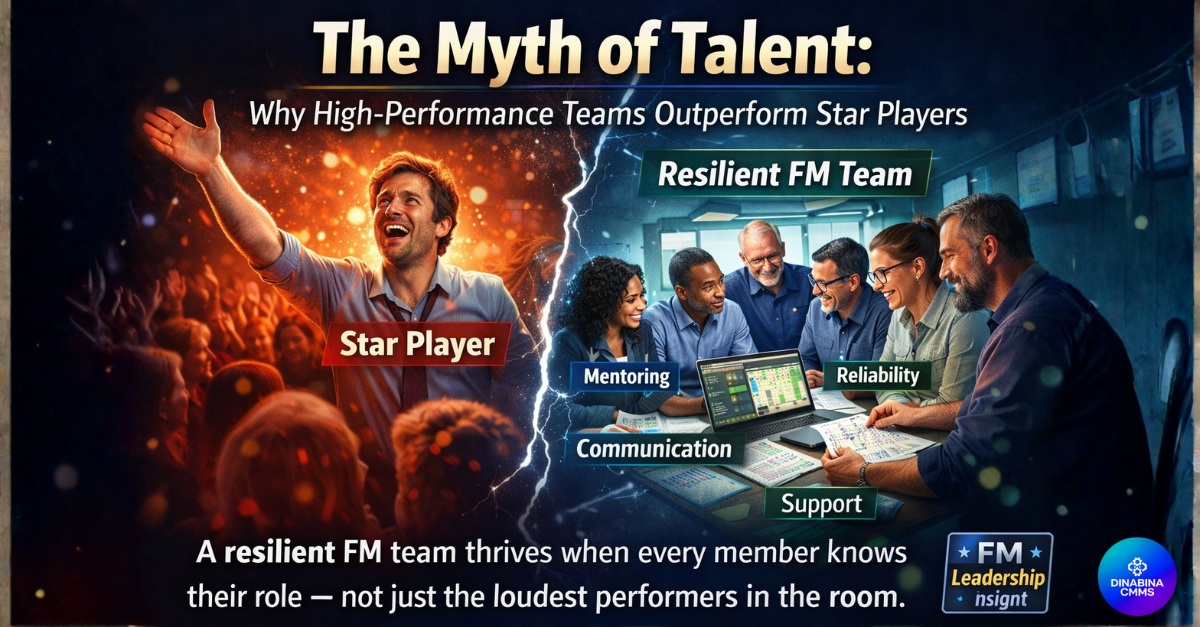
A resilient FM team thrives when every member knows their role — not just the loudest performers in the room.
Section 1: The Real Case for Superstars — Numbers Don’t Lie
Let’s not be contrarian for the sake of it. Superstars are genuinely extraordinary.
A landmark study by McKinsey & Company found that in complex, knowledge-intensive roles, a top performer outproduces their average peer by 400% or more. In roles that require advanced problem-solving — managing multi-site facilities, negotiating complex service contracts, integrating smart building technology — that gap is not just real, it is organizationally decisive.
In FM specifically, superstars often:
- Reframe problems that others accept as unchangeable constraints
- Compress timelines on capital projects through sheer focus and preparation
- Navigate stakeholders — from C-suite executives to contractors — with rare fluency
- Absorb ambiguity and deliver results without needing constant direction
- Spread energy that elevates the people working alongside them
What Makes a Superstar in FM? Six Defining Traits
Researchers and talent strategists have consistently identified six behavioral signatures that separate high performers from the merely competent:
| Trait | What It Looks Like in FM |
|---|---|
| Achievement orientation | Surpasses KPIs without being told to; finds inefficiencies before they become incidents |
| Radical self-awareness | Knows exactly where they add most value; delegates or asks for help on gaps |
| Comfort asking for help | Doesn’t let pride slow a project; sources expertise fast |
| Time compression mastery | Gets from A to Z in fewer steps than anyone else on the team |
| Pressure performance | Their best work surfaces in crises, not comfort |
| Contagious can-do spirit | Their habits, pace, and standards lift the ceiling for everyone around them |
These traits are most visible in what HR professionals call the “establishment phase” — early career, when challenges are fresh, energy is unlimited, and there is everything to prove.
The critical question no FM leader asks early enough: What happens when the establishment phase ends?dreamstime
The best FM superstars don’t just fix problems — they redesign how facilities work from the ground up.
Section 2: The Superstar Lifecycle — When the Glow Fades
Every superstar has a lifecycle. Ignoring it is one of the most expensive mistakes a facilities executive can make.
High performers mature in two parallel ways. First, they mature alongside the organization — the fast pace they set eventually becomes routine for everyone, including themselves. Second, they age chronologically, and with age come shifting priorities: family, stability, health, legacy.
The result? The energy that once defined them slows. And if the organization has not evolved around them, it faces a brutal double exposure: the system was built on their output, but their output is no longer what it was.
What FM Leaders Get Wrong About Fading Superstars
Most managers handle this badly in one of three ways:
- Ignoring the drift — hoping the high performer will self-correct
- Adding pressure, which accelerates burnout and resentment
- Forcing a promotion into management roles they neither want nor suit
All three strategies fail. The correct move is to meet superstars where they are, not where they were.
Four Evidence-Based Ways to Re-Engage Maturing High Performersolivebranchms+1

Man presenting charts to a diverse team in a modern office meeting
① Inject Meaningful New Challenges
Stagnation is a superstar’s greatest threat. The moment their work becomes predictable, their engagement starts bleeding out. FM leaders should proactively map new high-stakes projects — technology integration initiatives, sustainability audits, workplace transformation programs — that reignite their drive.
② Create Cross-Organizational Exposure
Superstars need to be around other high performers. Connecting them with interdepartmental stars — finance, technology, HR — for high-visibility projects satisfies their need for intellectual peer connection and signals that leadership recognizes their caliber. Mckinsey
③ Reframe Benefits for the Modern Era
High performers in today’s hybrid FM environment often respond to flexible arrangements, accelerated access to cutting-edge technology, and advanced professional development — not just financial rewards. Offering expanded autonomy and influence over how they work matters enormously.
④ Activate the Mentor Transition
This is the most powerful and most underused lever. When a superstar transitions from top individual contributor to mentor, they do not lose status — they gain legacy. They transfer institutional knowledge to junior staff, they become force multipliers rather than individual contributors, and they find renewed purpose in watching others grow.
Mentorship transforms individual brilliance into organizational momentum — the highest-leverage move for maturing FM superstars.
Section 3: The Hidden Architecture — Why Your Unsung Heroes Are Your Real Infrastructure
Here is the insight that catches most FM leaders off guard: the people who keep your building running are rarely the ones on anyone’s radar.
Every high-functioning FM organization runs on a layer of contributors who:
- Complete work orders accurately, every shift, without drama
- Maintain vendor relationships that took years to build
- Hold institutional memory — “don’t touch that valve before calling the city” — that no system has ever captured
- Show up when the superstar is absent, on holiday, or has moved on
These are the Unsung Heroes of FM. And they are the difference between an organization that performs consistently and one that only looks good when the stars align. Linkedin
The Dangerous Illusion of the All-Star Team

When a facilities executive staffs exclusively with superstars, they create several invisible structural problems:
- Role collision — High performers compete for impact, creating friction instead of synergy
- Operational blindspots — Nobody wants the “maintenance” work; critical processes fall through the gaps
- Knowledge concentration — Too much institutional knowledge in too few heads
- Cultural corrosion — Recognition hierarchies undermine the psychological safety teams need
- Fragility — Remove one or two stars, and the operation crumbles chronus
A study of high-performing teams across industries consistently shows that elite outcomes come from the right combination of talent types — not the highest average individual score.
Think of it like a championship football team. The striker scores the goals. But without the midfielders, the defenders, the goalkeeper, and the physio who taped the striker’s ankle on Tuesday, there is no match-winning goal on Saturday.
High-performing FM organizations are not collections of individual stars — they are ecosystems of complementary strengths.
Section 4: The Authenticity Arc — Principles → Process → Proof
One of the most powerful frameworks for building an FM organization that transcends individual talent is The Authenticity Arc. It moves through three phases, each harder to fake than the last:
Phase 1: Principles — The Easiest to State, Hardest to Live
Your principles define what your FM organization stands for when no one is watching. They are not values on a wall; they are decisions made under pressure.
Examples of FM principles that translate into resilience:
- “No critical task depends on a single person.”
- “We measure what the business cares about, not just what is easy to track.”
- “Every incident is a system failure first, a people failure second.”
- “We invest in documentation before we invest in headcount.”
Principles like these reshape hiring, budgeting, and incident response. They tell your team — and your superstars — what the organization is actually optimizing for.
Phase 2: Process — Where Principles Become Operational
Processes are how principles survive reality. In FM, world-class process design means:
- Asset and task documentation that lives in shared systems, not personal notebooks
- SOP libraries for every critical function — shutdowns, emergency response, vendor handover, compliance inspections
- Skills matrices that show exactly who can cover what, and where training gaps exist
- Cross-training rotations are built into the annual calendar, not left to chance
- CMMS/CAFM integration that captures history, schedules, and data — independent of which individual performed the workmckinsey
When your processes are this robust, your superstars can focus on what they do best — innovation, relationship management, strategic projects — rather than serving as the emergency backstop for everything that lacks documentation.
Phase 3: Proof — The Hardest to Fake

Proof is what transforms your principles and processes from theory into organizational credibility.
Proof looks like:
- Stable performance metrics even during planned leave for key staff
- Incident reports that show system learning, not blame
- Stakeholder feedback that praises team reliability, not just individual heroics
- Succession outcomes — junior staff who stepped up and delivered, documented, and visible
Proof is also the raw material of your organization’s external story — the case studies, the before-and-after metrics, the testimonials that position your FM team as a strategic asset rather than a cost center.
Smart building management systems are not just operational tools—they are the backbone of a team that can perform without depending on any single person.
Section 5: Regulatory Safeguards — The Invisible Grid That Protects Everyone
One underappreciated reason FM organizations need systematic resilience rather than individual genius: regulation does not care who your best person is.
Fire safety compliance, building codes, environmental standards, and occupational health requirements — all of these demand documented, auditable, repeatable processes that work regardless of who is on shift.
A superstar-dependent FM team carries extraordinary regulatory exposure. When that superstar is the primary holder of compliance knowledge — schedules, certifications, contractor agreements, inspection records — their absence creates legal and safety risk as well as operational disruption.
The Five Non-Negotiable Compliance Safeguards
- Documented compliance calendars accessible to all senior FM staff
- Redundant certification coverage — at least two people qualified to approve and sign off on critical inspections
- Vendor governance structures that include backup contacts, scope documents, and renewal schedules
- Digital audit trails in integrated CMMS platforms rather than personal files
- Quarterly compliance reviews led by rotating team members, not always the same individual
These safeguards are not bureaucratic overhead. They are the immune system of your organization — invisible when healthy, catastrophic when compromised.
Section 6: The Digital Marketing Imperative — Making FM Visible Before It Becomes Invisible
Here is a strategic reality most FM leaders overlook: the same communication skills that make superstars powerful internally can be systematized externally.
Publishing on high-domain-authority (DA) platforms — LinkedIn, Medium, IFMA’s FMJ, industry association blogs — does for your organization’s reputation what great operations do for your building: it creates durable, compounding value.facilitiesmanagementadvisor+1
Why This Matters More Than Ever
- Improved Search Rankings: High-DA platforms carry authority that helps your content surface in relevant searches, increasing visibility with potential recruits, clients, and partners.
- Expanded Audience Reach: LinkedIn alone has hundreds of millions of active professionals. Thought leadership posts, case studies, and tutorials reach audiences your organization could never build from scratch.
- Enhanced Organizational Credibility: When FM leaders publish grounded, evidence-based content on respected platforms, the team transitions from “facilities people” to recognized domain experts, reshaping every internal budget conversation that follows.
Five Content Formats That Work for FM Thought Leadership

- Incident case studies (anonymized): What broke, why, how the system responded, what changed
- Tutorial posts: Step-by-step walkthroughs of processes like energy audits, vendor onboarding, or asset lifecycle management
- Listicles: “7 Signs Your FM Team Is Too Dependent on One Person” — immediately shareable, highly clickable
- Data stories: Before-and-after metrics from technology integrations, sustainability upgrades, or process redesigns
- Poll-driven discussions: Questions about talent strategy, technology adoption, or team structure that invite community engagement
FM organizations that document and share their systems thinking attract better talent, build greater trust, and earn the strategic seat they deserve.
Section 7: Tutorial — The 30-Day FM Resilience Sprint
You do not need a six-month transformation program. You need 30 days, discipline, and honesty about where your operation is fragile.
Week 1: Diagnose the Dependency Map
- List the ten tasks that would stall if your top two performers were unavailable tomorrow
- Identify every critical process owned by a single person
- Map vendor relationships that exist only through one point of contact
- Flag compliance records that exist only in personal files or local drives
Week 2: Document the Critical Three
Choose the three most dangerous dependencies and create:
- Step-by-step SOPs (no longer than two pages each)
- Short screen-capture videos of digital workflows
- Quick-reference cards for emergency scenarios
- Shared access credentials for critical platforms and systems
Week 3: Cross-Train with Real Accountability
- Assign named backups for every critical function
- Run tabletop simulations: backup leads, superstar observes and corrects
- Document the questions that surface during simulations — they reveal every gap
- Schedule a follow-up simulation 60 days out
Week 4: Measure, Communicate, Celebrate
- Share the updated resilience framework with organizational leadership
- Track a dashboard of three to five metrics: response time, ticket backlog, compliance completion rate
- Publicly recognize contributors who stepped up during cross-training
- Convert the sprint into a case study for internal and external sharing
Section 8: Innovative Discoveries — What Smart FM Leaders Are Learning in 2026
The FM industry is not standing still. Three convergent developments are fundamentally reshaping how talent strategy and operational resilience intersect:
① IoT-Enabled Shared Situational Awareness
Connected sensors, real-time dashboards, and predictive maintenance algorithms mean that the kind of environmental intelligence a superstar once held in their head is now accessible to any trained team member looking at the right screen. This democratizes competence — and reduces single-person risk.
② Scalable Credential Frameworks
Global FM bodies are now offering structured, modular training pathways that lift baseline competence across entire teams — not just individual high-flyers. Organizations that invest in these programs find that average performer output improves dramatically, narrowing the gap that creates superstar dependency in the first place.
③ Narrative-Driven FM Leadership
The most forward-thinking FM leaders are learning that storytelling — structured, data-grounded, visually compelling storytelling — is as operationally important as any technical skill. When FM teams can articulate their impact in language that resonates with finance, HR, and the C-suite, they stop being defended and start being invested in.
Section 9: The Listicle — 9 Signs Your FM Team Is Running on Hero Fuel
If four or more of the following apply to your organization, you have a superstar dependency problem:
- The same person’s name appears in every urgent email thread
- Vendor relationships exist person-to-person, not organization-to-organization
- Critical knowledge lives in individual notebooks, personal drives, or one person’s memory
- Planned leave for certain staff creates visible anxiety across the team
- Junior staff rarely encounter complex problems — superstars handle everything challenging
- Post-incident reviews focus on who made the mistake, not how the system allowed it
- New staff feel they cannot add value until they have “proven themselves” to the top performers
- Performance noticeably drops whenever specific individuals are away
- When a superstar resigns, it takes six months or more to stabilize operations
Each item is an invitation — not a condemnation. Every gap identified is an opportunity to build something more durable.
Section 10: A Story — When the System Becomes the Hero
A facilities head at a large corporate campus in Pune had spent eight years quietly depending on one master technician who knew every system in the building intimately. The technician knew which chiller had a quirky pressure sensor, which backup generator needed a manual nudge to start, and which vendor to call at 2 a.m. for elevator emergencies. He never documented any of it. He didn’t need to — he was always there.
When he suffered a health emergency during a critical board event week, the campus nearly went dark — literally.
Two years later, after implementing a full CMMS, cross-training every technical role, and running quarterly resilience drills, the same campus handled a major monsoon-related power disruption with zero escalations. No single person’s name appeared in the incident report. The system worked.
The lesson: In Indian FM operations, where institutional knowledge is often oral and interpersonal, the transition from hero-dependence to system-resilience is not just good management — it is organizational survival.
Conclusion: The Organization That Outlasts Any One Person
The highest form of FM leadership is not assembling the most impressive roster of talent. It is building an organization whose performance does not fluctuate with who happens to be on shift.
Superstars are essential. They set the ceiling of what is possible. But unsung heroes define the floor — the daily, consistent, below-the-radar execution that determines whether occupants feel safe, assets remain functional, and compliance is never an incident waiting to happen.
The future belongs to FM leaders who hold both truths simultaneously: recruit and develop superstars relentlessly, while designing systems, processes, and cultures that make great performance the baseline — not the exception.
Build the team. Build the system. Then tell the world about it.
🔖 Call-to-Action Questions
- Where in your FM operation are you one person’s absence away from a serious disruption — and what is the first process you will document this week?
- Who are the unsung heroes on your team right now who deserve recognition, mentorship, and a path to greater impact?
- How will you tell your FM team’s resilience story externally this quarter — and on which platform will you start?
“Together, We Keep It Alive”
Words find meaning when hearts stay connected.
If this reflection reached you, your small act of support keeps the light of shared purpose alive.
Please write to us at dinabinamarigold@gmail.com for an invoice, if required.